
Recently, I attended a webinar about becoming a funnel builder, and something the speaker said caught my attention.
He claimed that businesses do not need websites anymore as long as they have sales funnels. He even went further to discredit businesses that still invest in websites. One of his customers also came forward to testify that having a website is useless.
I strongly disagree.
Not because sales funnels are not important. They are very important. But because saying “businesses don’t need websites anymore” is not only inaccurate, it is misleading.
A sales funnel and a website do not serve the exact same purpose. A serious business needs to understand the role of both.
A Funnel Is Not a Replacement for a Website
A sales funnel is designed to guide a visitor toward a specific action.
That action may be to:
- Book a consultation
- Download a free guide
- Register for a webinar
- Buy a product
- Fill out an application
- Join an email list
- Request a quote
That is valuable.
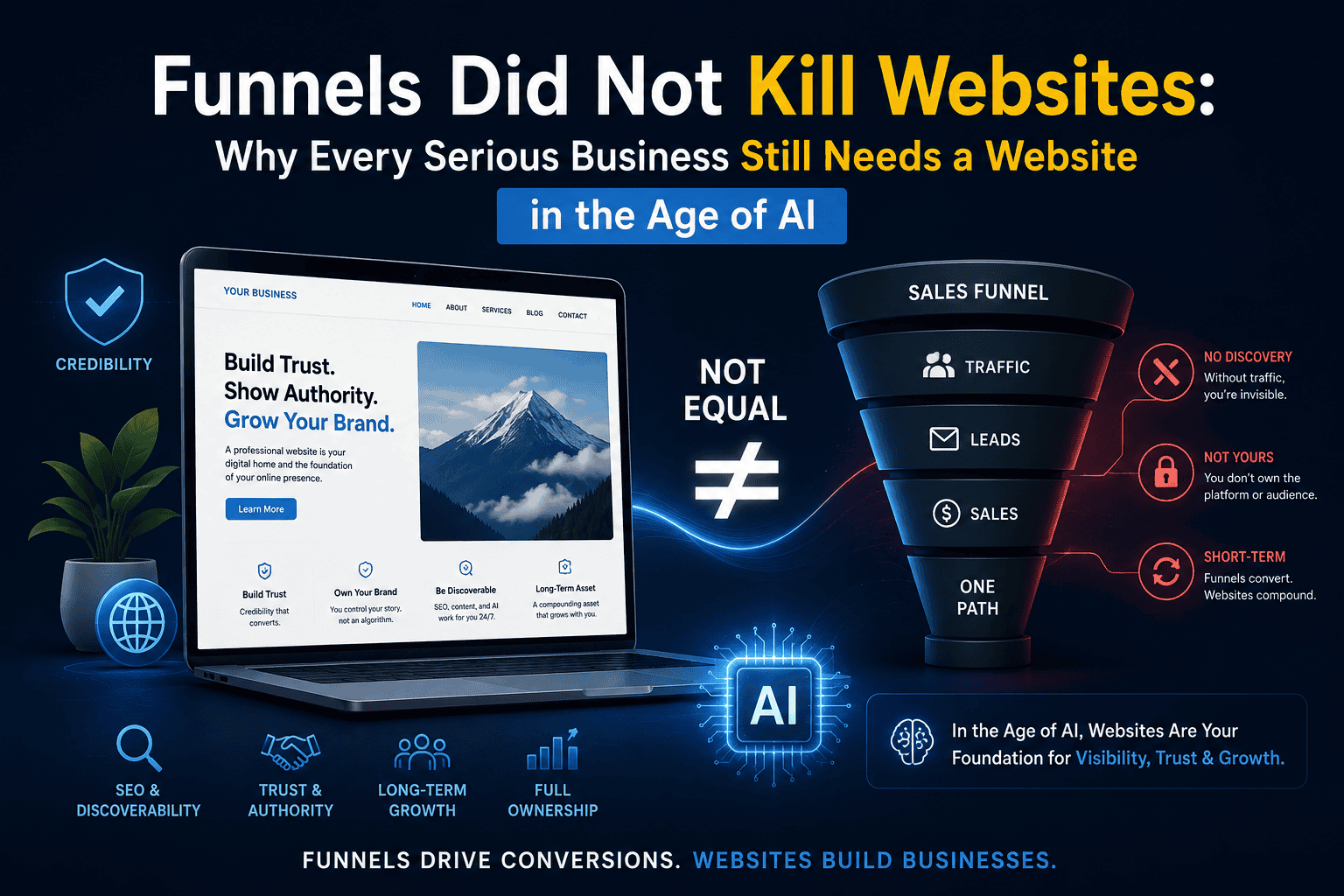
But a website has a broader purpose. A website is the digital headquarters of the business. It gives people a place to verify the business, understand its services, read about the company, check credibility, explore resources, find contact information, and discover the business through search engines.
A funnel is usually campaign-specific.
A website is brand-specific.
A funnel may help you convert traffic.
A website helps you build trust, authority, visibility, and long-term business equity.
Confusing the two is a serious marketing mistake.
The Real Problem Is Bad Websites, Not Websites Themselves
Many people who say websites are useless are usually reacting to poorly designed websites.
And to be fair, they have a point.
A website that only has a homepage, an about page, a contact page, and no real strategy is weak. A website that looks beautiful but does not generate leads is incomplete. A website that is not connected to a CRM, tracking system, booking system, email automation, or clear call to action is underperforming.
But that does not mean websites are useless.
It means many websites are badly planned.
That is like saying offices are useless because some offices are disorganized. Or saying cars are useless because some people drive broken vehicles.
The issue is not the website.
The issue is the strategy behind the website.
In the Age of AI, Websites Are Becoming More Important, Not Less
This is where the “websites are dead” argument completely collapses.
We are now in an era where customers are not only searching through traditional Google results. They are also using AI-powered search experiences, Google AI Overviews, ChatGPT-style tools, Perplexity, Bing Copilot, and other answer engines to discover information and make decisions.
Google’s own SEO documentation explains that SEO helps search engines understand your content and helps users find your site and decide whether to visit it. (Google for Developers)
Google also explains that AI Overviews provide snapshots of information with links that allow users to explore more on the web. (Home)
So the question is simple:
If your business does not have a strong website with clear content, service pages, FAQs, location information, authority signals, and structured information, what exactly will search engines and AI tools use to understand and recommend your business?
Your funnel alone will not solve that.
A funnel may be good for a paid ad campaign, but your website is what strengthens your discoverability, credibility, and authority across the broader digital ecosystem.
Funnels Are for Conversion. Websites Are for Trust, Search, and Authority.
A good funnel is like a focused sales conversation.
A good website is like a complete business office online.
The funnel says:
“Take this specific action now.”
The website says:
“Here is who we are, what we do, why we are credible, how we can help you, what we offer, what people say about us, and how to take the next step.”
Both are useful.
But they are not the same.
A funnel without a website can work in some cases, especially for a short-term campaign. But a funnel without a strong brand foundation can also look suspicious, especially for professional services, tax firms, law firms, medical services, consultants, agencies, and financial service providers.
People may click your ad, land on your funnel, and still open another tab to check your business website, reviews, social proof, and online presence.
That is human behavior.
People want to verify before they trust.
A Business Website Should Not Be Just an Online Brochure
This is where website designers must also accept responsibility.
The old model of website design is no longer enough.
A modern business website should not just be a digital flyer. It should be connected to the business growth system.
A standard business website today should include:
- Clear positioning
- Strong homepage messaging
- Service pages
- Search engine optimization
- Local SEO support
- Clear calls to action
- Lead capture forms
- Booking links
- CRM integration
- Automation triggers
- Analytics tracking
- Testimonials or reviews
- FAQs
- Trust-building content
- Mobile responsiveness
- Fast loading speed
- Privacy policy and compliance pages
Without these, the website is weak.
But again, that does not mean the business does not need a website. It means the business needs a better website.
Google Business Profile Alone Is Not Enough Either
Some business owners may say, “I have a Google Business Profile, so I don’t need a website.”
That is also wrong.
Google Business Profile is important. Google describes it as a tool that helps businesses show up on Google Search and Maps, allowing customers to find them and build trust. (Google Help)
But a Google Business Profile is still not your owned platform.
Your website is where you control your message, offers, content, case studies, service explanations, lead capture, and customer journey.
Google Business Profile helps people find you.
Your website helps people understand and trust you.
Your funnel helps people take action.
Your CRM helps you follow up.
Your automation helps you nurture and convert.
That is the real modern business growth system.
Why the “Website vs. Funnel” Debate Is the Wrong Debate
The real question is not:
“Should a business have a website or a funnel?”
The better question is:
“How should the website and funnel work together to generate visibility, trust, leads, and sales?”
A website and funnel should not fight each other. They should support each other.
For example:
A business may have a main website for authority and SEO.
Then it may have specific funnels for:
- Tax consultation
- Business formation
- Bookkeeping services
- Webinar registration
- Free guide download
- Appointment booking
- Product sales
- Course enrollment
- Grant readiness assessment
- Business credit consultation
The website becomes the central digital headquarters.
The funnels become focused conversion pathways.
That is the right strategy.
The Dangerous Advice: “You Don’t Need a Website”
When someone tells business owners they do not need a website anymore, that advice can damage their long-term growth.
It can make them overdependent on ads.
It can weaken their SEO.
It can reduce their brand credibility.
It can make them invisible in organic search.
It can prevent AI-powered search tools from properly understanding their business.
It can make them look less established.
It can force every lead to come through paid traffic or direct promotion.
That is not smart business strategy.
That is short-term thinking.
Funnels are powerful, but they are not a complete business presence.
The Better Way to Think About It
Every serious business should think in terms of a complete digital growth ecosystem.
That ecosystem includes:
1. Website
For credibility, authority, SEO, education, and brand control.
2. Sales Funnels
For campaign-specific conversions.
3. CRM
For managing contacts, leads, opportunities, and customer relationships.
4. Automation
For follow-up, reminders, nurturing, onboarding, and reactivation.
5. Content
For search visibility, thought leadership, and trust building.
6. Analytics
For tracking performance and making better decisions.
7. AI Tools
For research, content creation, personalization, customer support, and operational efficiency.
This is the future.
Not website alone.
Not funnel alone.
But an integrated business growth system.
My Final Position
A business does not need a useless website.
A business does not need a pretty website that does nothing.
A business does not need a website built without strategy, SEO, automation, or conversion planning.
But every serious business needs a strong digital headquarters.
That digital headquarters is still the website.
Funnels did not kill websites.
Funnels exposed bad websites.
The right answer is not to abandon websites. The right answer is to build websites that are strategic, searchable, credible, connected, and conversion-ready.
Join the Tax, AI, and Business Circle
If you are a business owner, tax professional, entrepreneur, consultant, or digital service provider trying to understand how websites, funnels, AI, automation, CRM, SEO, and business strategy now work together, I invite you to join my community:
Tax, AI, and Business Circle — TABC
Inside the community, we discuss practical strategies for using tax knowledge, AI tools, digital marketing, automation, and business systems to build smarter and more profitable businesses.
Because the future does not belong to people who chase one tool at a time.
It belongs to those who understand how the whole system works.